A safety table looks like a list of symptoms beside numbers. Behind each row is a sequence of decisions: what qualified for recording, how the information reached the investigators, which people were counted and what comparison was made. Reading that sequence is more useful than treating the smallest displayed percentage as a ready-made answer about a treatment.
This article develops an original framework for examining those decisions, using the study record and chart below as context. The invented logs and scenarios are teaching examples, not undisclosed participant histories. They show why a temporal record, a count of affected people and a judgment about cause need different information, even when all three concern the same reported event.
Read the reported result
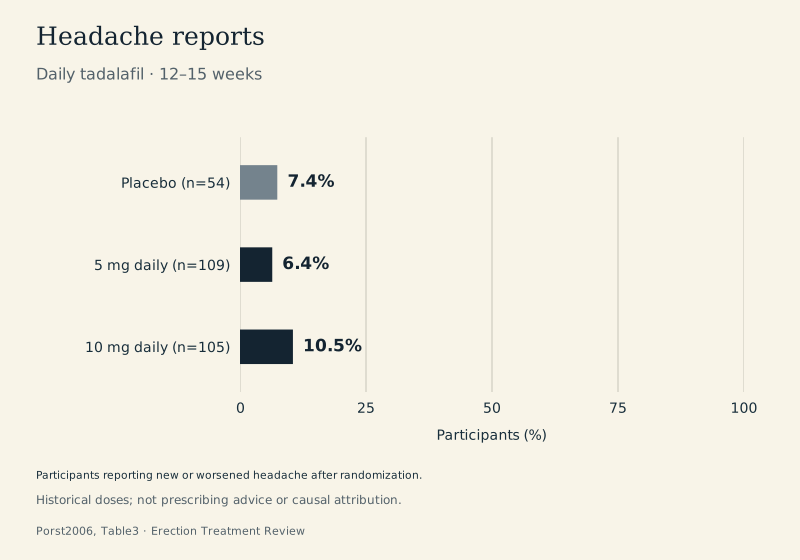
| Group | Percent | Reported n/N |
|---|---|---|
| Placebo | 7.4% | 4/54 |
| 5mg daily | 6.4% | 7/109 |
| 10mg daily | 10.5% | 11/105 |
Tadalafil: new or worsened headache reports over 12–15 weeks.
Participants, not episodes. Historical doses; not prescribing advice or causal attribution.
1An observation and a causal judgment are separate entries
Begin with a blank event record and give it separate spaces for description, timing and interpretation. The description says what was reported. The timing places it relative to other observations. The interpretation addresses possible causes. Combining these spaces into a single label can make an unresolved explanation look like something directly observed, even when the original entry was much narrower.
For example, an invented log might say that a symptom began after a scheduled activity. That ordering is relevant, but it does not tell us what would have happened without the activity. Nor does the absence of a confident explanation erase the reported experience. The record can be important before every causal question has been answered. Those are compatible positions, not competing ways to take an event seriously.
This distinction improves the language used in a review. State what the record establishes before describing what it might suggest. An interpretation should remain visibly conditional when the information cannot separate possible explanations. Our guide to evaluating treatment claims uses the same approach: the verb in a sentence should match the kind of evidence available.
1Choose between people and episodes before doing arithmetic
Imagine a deliberately fictional log for ten people. One person reports four episodes of a symptom, another reports one, and the other eight report none. There are five episodes and two affected people. Neither total is inherently wrong. The error would be to calculate with one counting unit and then describe the answer as though the other had been counted.
A person-level proportion asks whether each eligible person met the reporting condition at least once. An episode count asks how many occurrences were recorded. The first does not describe repetition; the second does not directly describe the share of people affected. Moving between them requires the underlying links connecting occurrences to people, not a change of label beside the total.
The table keeps the invented records deliberately small so the distinction can be inspected. Real summaries may contain more categories and longer observation, but the logical requirement is the same. Define the thing being counted first. If a person contributes several entries, preserve that relationship when interpreting burden rather than allowing repeated entries to masquerade as additional people.
| Invented records | Episode contribution | Affected-person contribution |
|---|---|---|
| Person A reports four episodes | 4 episodes | 1 person |
| Person B reports one episode | 1 episode | 1 person |
| Eight people report none | 0 episodes | 0 people |
| All ten fictional people | 5 episodes in total | 2 of 10 people affected |
The denominator describes the population behind the statement
A numerator acquires meaning from the population placed beneath it. A count divided by all eligible people differs conceptually from the same count divided by people attending a particular visit. The denominators might happen to have the same numerical size, but that would not make the selection rules identical. Their definitions, rather than their appearance, determine the statement being made.
Observation time adds another dimension. Imagine two fictional records with the same number of people but different lengths of observation. A percentage alone does not reveal that difference. Calculating an incidence rate would require suitable person-time information; it cannot be recovered merely by dividing a displayed percentage by an assumed study duration. The missing unit must come from a record, not from convenience.
A review should therefore carry three labels together: what was counted, who was eligible to count and when observation occurred. This also helps when examining a treatment offer. If an offer borrows the language of a research result, ask whether it retains the population and time conditions that make the number interpretable.
1The route into the record deserves attention
Consider two imaginary collection procedures. In one, a person is invited to mention concerns freely. In another, the person is asked about a fixed list at scheduled intervals. These procedures could make different information available because the prompts and opportunities differ. That is a question about ascertainment—how observations are sought and recorded—not an automatic verdict that either record is false.
The next question is whether the procedure was applied consistently across the comparison. A change in questioning after an assumption about treatment could create another explanation to investigate. But a reader should not invent such a change simply because it is conceivable. A methodological possibility becomes a finding only when evidence supports its occurrence in the specific setting under discussion.
This way of reading encourages useful requests for documentation. Ask how an event reached the record, what qualified it for inclusion and whether the procedure is described clearly enough to understand. The broader habit also helps when checking the pharmacy behind a prescription: an attractive conclusion should not substitute for the documented process relevant to that conclusion.
1A comparator informs a group question
A comparison group gives a researcher a way to examine occurrence under another assigned condition. That is valuable because a symptom observed during one condition need not be absent from the other. The resulting comparison concerns groups observed through a defined design. It does not reveal the unobserved alternative history of a particular person who experienced an event.
Imagine an affected participant asking whether the same symptom would have occurred without that assignment. A group comparison may inform the broader causal inquiry, but the individual’s alternate course cannot be observed alongside the actual course. Personal attribution may require information about timing, other exposures and clinical circumstances. A percentage cannot supply those missing details merely because it comes from a controlled experiment.
Knowledge of assignment is another part of that inquiry. Our sildenafil article on blinding and patient reports separates a design procedure from evidence about what people knew. The connection here is methodological: protect the comparison where possible, describe the observations precisely, and keep a proposed explanation distinct from the experience that prompted it.
15Frequency, burden and stopping answer different questions
Two fictional records can count the same number of affected people yet describe very different experiences. One might contain brief isolated symptoms; another might contain repeated interruptions. A person-level count would preserve the shared fact of occurrence while omitting those differences. More detailed records would be needed to describe duration, interference or recurrence, rather than assuming them from the count.
Stopping treatment is a further observation, not a synonym for symptom severity. In an illustrative scenario, a person could continue despite a troublesome event or stop after a milder concern because of priorities that are not recorded in the table. This is not a diagnosis of anyone’s behavior. It demonstrates why an action and the experience preceding it deserve separate columns.
The distinctions below are an original reading aid, not a formal regulatory classification. Each row identifies an additional question that would require additional evidence. A compact safety summary becomes more informative when its limits lead to specific follow-up questions. It becomes less informative when one dimension—such as occurrence—is stretched to stand for every aspect of tolerability.
| Imagined entry | Question it could address | Question still requiring evidence |
|---|---|---|
| A symptom is recorded once | Did a qualifying report occur? | How disruptive was it? |
| Several occurrences are linked to one person | Was the experience repeated? | What explains the repetition? |
| The person describes substantial interference | How much did it interfere? | Did it lead to stopping treatment? |
| Treatment is stopped after a concern | What action followed? | Which reasons contributed to that action? |
A difference needs precision and a compatible comparison
Ordering several percentages from smallest to largest is an arithmetic task. Deciding whether that ordering supports a treatment preference is a different task. It requires a question about the comparison and information about uncertainty. The position of a bar does not specify how much the estimate might vary under the study’s sampling and analysis conditions, nor what difference would matter for the intended decision.
A confidence interval, when reported for the relevant contrast, can address precision under its stated assumptions. A reader should not manufacture one from an incompatible denominator or use the overlap of unrelated intervals as a universal decision rule. Likewise, failing to establish a difference would not, by itself, establish equivalence. Those conclusions answer different statistical questions and require their own analyses.
Current Cialis labeling cautions that adverse-reaction rates from different clinical trials are not directly comparable and may not reflect practice. The practical implication is to inspect compatibility before comparing tables: the counted event, collection procedure, population, observation and analysis all matter. This does not prohibit comparison. It identifies the work needed before a numerical contrast earns a clinical interpretation.
21A research arm is not a personal dosing instruction
Current Cialis labeling for daily erectile-dysfunction treatment starts at 2.5 mg and allows an increase to 5 mg. Historical 10 mg daily is not that routine regimen. This distinction keeps a research design in its proper role: it identifies a comparison that was investigated, without converting the existence of an arm into a recommendation for the person reading about it.
A number can serve several roles on a page. It might identify a study group, describe a supplied product or state a clinician’s selected prescription. Those roles should not be inferred from typography alone. A larger or smaller number in a research table does not decide which instruction belongs to an individual. The source and purpose of the number must remain attached to it.
Use the guide to reading an ED product label to separate ingredient identity, formulation and instructions. A scientific article can help frame a question about why an arrangement was studied. It cannot settle the individual assessment that determines a prescription. Reading a table responsibly means preserving that boundary while still examining the research in detail.
21Personal warning signs need a clinical response
Cialis labeling contraindicates nitrates and riociguat. Daily use maintains exposure between sexual encounters, so interactions remain relevant. An erection lasting more than four hours needs emergency care. Sudden vision loss requires stopping treatment and immediate medical contact; sudden hearing loss requires stopping and prompt attention. Chest symptoms during sex require stopping activity, immediate help and disclosure of recent use. Do not combine ED medicines without clinical direction.
A safety table is not a triage system for deciding whether a particular symptom deserves attention. The table summarizes a defined record; the person experiencing a problem has an immediate situation to assess through appropriate care. Waiting for certainty about cause would confuse the scientific question with the practical response. Clinical attention and later investigation of causation can serve different needs.
Bring the whole medicine list into the review, together with the information the clinician requests about the actual concern. Related medicines have their own prescribing documents; familiarity with one does not authorize borrowing instructions for another. A useful conversation can acknowledge uncertainty about attribution while still addressing the person’s circumstances, current treatment and next steps through the care team.
23A provider record cannot inherit a trial’s safety profile
A named product creates another evidence question: what is the finished preparation, and what research is applicable to it? An ingredient name alone does not establish the complete connection. A review needs to distinguish the tested object from the item described in an offer before drawing conclusions about what a study can contribute to that offer’s assessment.
FDA states that compounded drugs are not FDA-approved and do not undergo its premarket review for safety, effectiveness or quality. That regulatory distinction is not a measured outcome for any individual service. Our editorial interpretation is to keep the preparation record open alongside the scientific record, rather than letting the familiarity of an ingredient silently complete the argument.
The Ro Daily Tadalafil review and Hims Tadalafil review provide places to inspect documentary terms and formulation questions. Linking those records does not attribute the trial’s results to either provider. End with a precise unresolved question about the proposed preparation or care arrangement; do not convert a research percentage into a service rating or a personal safety guarantee.
41Questions about the evidence
Does an event occurring after treatment prove that treatment caused it?
The ordering is relevant information, but it does not supply the alternative history needed to settle causation by itself. A report can deserve attention while its explanation remains uncertain. Keep the observed timing and the causal assessment visible as separate parts of the record.
1Why can an episode count be larger than the number of affected people?
One person can contribute several occurrences. A summary of episodes and a summary of people answer different questions, so the counting unit must be named before a proportion is calculated. The fictional example in this article illustrates that arithmetic and does not reconstruct trial participants.
1Does the lowest displayed percentage identify the safest option?
Its position in an ordered list does not establish that conclusion. A treatment preference would require an appropriate comparison, uncertainty assessment and a definition of safety broad enough for the intended decision. Frequency of one recorded event is only one dimension to examine.
12Can a safety table explain how disruptive a symptom felt?
Only if the record actually includes information addressing disruption. Occurrence, repetition, duration, interference and stopping treatment are different observations. A reader should request the dimension needed for the question, rather than infer it from a count that was designed to describe something else.
1What makes an uncertainty useful rather than merely frustrating?
Translate it into a specific missing observation: which people were counted, how the report was collected, what comparison was made, or which details belong to the individual situation. That turns a vague concern into a question a source or care team may be able to address.
12A useful question to carry forward
Read the event description, counting unit, denominator and observation process before interpreting a safety percentage. Then separate the group comparison from the question of cause in one person. This approach neither dismisses reported experiences nor gives every report a causal label. It preserves the information needed to ask a more specific scientific question and to keep personal care decisions with the appropriate clinician.
Evidence access
Retained full papers; official documents checked October 25, 2026. No separate protocols, supplements or individual records examined.
Source record
Scientific sources have their own checked dates below. Earlier source records retain their original checks. Medical resources and labeling supply general context. Provider-owned pages establish advertised terms, not independently tested outcomes.
- Porst 2006Study · Checked 2026-10-25
- Cialis prescribing informationOfficial prescribing information · Checked 2026-10-25
- Viagra prescribing informationOfficial prescribing information · Checked 2026-10-25
- FDA: compounded drugsFDA guidance · Checked 2026-10-25
- Goldstein 1998Primary research · Checked 2026-10-25