A research result begins with decisions that happen before anyone calculates an average. One decision determines who receives each treatment. Another concerns who knows that assignment. A third determines what experience becomes a recorded answer. Keeping those decisions separate helps a reader understand the strength of an experiment without asking a single design label to do every job.
We use the research record and chart below as a starting point for original methodological analysis. The examples that follow are deliberately invented thought experiments, not reconstructed participants or undisclosed study records. Their purpose is to make a practical distinction visible: confidence in a comparison and clarity about what was measured belong together, but they are not interchangeable.
Read the reported result
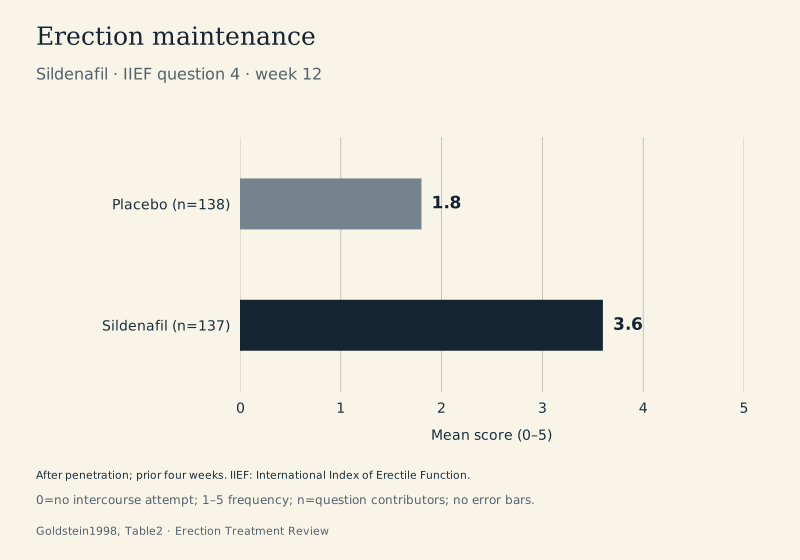
| Group | Mean | Analyzed n |
|---|---|---|
| Placebo | 1.8 | 138 |
| Sildenafil | 3.6 | 137 |
IIEF question 4: erection maintenance after penetration; week 12, prior four weeks.
0=no attempt; 1–5=frequency. Analysis contributors only; no error bars.
1Assignment and knowledge are separate decisions
Start by drawing two boxes on a page. Label one assignment and the other knowledge. Random assignment concerns the rule that places a person in a treatment group. Concealment of the upcoming assignment concerns what can be known before that placement occurs. Masking concerns information available afterward. These are different points in the sequence, so evidence about one does not automatically describe the others.
As a conceptual example, imagine an allocation list generated by chance but visible to someone deciding whom to enroll next. Compare that with a concealed list followed by openly labeled treatment packages. The first situation raises a question about selection before assignment; the second raises a question about knowledge after assignment. Neither description tells us what actually happened in the research summarized here.
This separation also makes a review more precise. Instead of saying that a study was carefully designed and stopping there, identify the decision protected by each procedure. Then ask which details were documented. Our guide to evaluating treatment claims applies the same discipline to the sentence an offer asks a reader to accept.
1A personal report can answer a defined scientific question
A report about an experience is not disqualified merely because the person experiencing it supplies the answer. If the question concerns how something felt, a mechanical measurement would not automatically capture the same subject. The important first step is to identify the experience named by the question, rather than sorting measurements into a simple hierarchy of objective and subjective.
Consider a fictional questionnaire about how often an activity was manageable. Its answer could be useful for that stated purpose while leaving comfort, satisfaction and the reason for difficulty unresolved. Adding more precise wording would improve our understanding of the recorded construct—the particular feature being measured—but would not turn the answer into a complete account of someone’s life.
Masking and measurement therefore deserve separate assessments. A carefully concealed assignment cannot expand the meaning of a narrow question. Conversely, a broad and relevant question does not establish that knowledge of treatment was controlled. The reader should be able to explain both the comparison procedure and the scope of the answer without using one as a substitute for the other.
1Looking alike and knowing the assignment are different observations
The following fictional design sketches separate an intervention intended to protect masking from evidence about what people actually knew. They are hypothetical experiment records, not descriptions of this trial. A photograph of identical packages could document appearance; it would not, by itself, reveal every conversation, belief or later clue available to a participant or an assessor.
That distinction does not make matching appearances pointless. It identifies the particular route by which matching could reduce information: visible packaging would become less useful as a clue. A broader claim about sustained masking would need broader evidence. Even then, the question should name whose knowledge matters, because a participant, an interviewer and a laboratory analyst occupy different positions in the observation process.
A useful review preserves this chain of reasoning. First describe the protective procedure. Next identify the information it addresses. Finally distinguish that procedure from a measured result about knowledge. Skipping the middle step encourages an absolute claim that no one could know an assignment, when the evidence may support only a narrower statement about the design.
| Invented record | What it directly documents | Additional question |
|---|---|---|
| Packages look identical | A visible feature was matched | What other information was available? |
| An interviewer cannot see assignment codes | That person lacks that source of information | Could the participant reveal an assumption? |
| Treatment guesses are collected | Beliefs were recorded at a stated time | What shaped the guesses before that time? |
A correct guess does not establish which way influence ran
Suppose an imaginary participant reports feeling better and then guesses that the active treatment was received. There are at least two possible stories to investigate. An earlier belief might have influenced a later report, or an experienced change might have influenced the later guess. A correct guess recorded at the end does not, on its own, distinguish those directions.
The ordering of observations matters here. An assessment of belief before an outcome and another afterward answer different questions. So do guesses made confidently and guesses made reluctantly. This is a reasoning exercise about the evidence needed to examine an explanation; it is not a claim that masking failed, that expectations caused an observed result, or that a particular belief assessment was performed.
The same discipline applies when an event occurs after treatment. Sequence supplies useful information without resolving every causal question. Our companion analysis of daily tadalafil and adverse-event reports develops that issue through the structure of a safety record. Across both questions, an appealing story becomes stronger only when the observations distinguish it from plausible alternatives.
15An average keeps arithmetic, not every person’s answer
The next table is entirely invented. Assign numerical codes to an imaginary ordered response scale and consider two four-person lists. Each list has the same total and therefore the same mean, yet the answers are distributed differently. The calculation is exact arithmetic; the choice of codes and the meaning of the response categories remain separate decisions.
This explains why a mean should not be narrated as the experience of a representative person who actually gave that answer. It is a summary of the chosen numerical coding. Two groups could share that summary while differing in how responses cluster. A reader interested in the distribution would need the distribution, rather than an increasingly detailed story built around the mean alone.
Nor does dividing a score by its maximum create a success probability. A fraction of the numerical scale is still a statement about that scale. To calculate a proportion of people meeting a criterion, the criterion must be specified and the people satisfying it counted. The two operations answer different questions even when their resulting numbers happen to look familiar.
| Fictional scores | Arithmetic summary | What the mean leaves open |
|---|---|---|
| 1, 1, 5, 5 | Total 12; mean 3 | Responses occupy the low and high categories |
| 2, 3, 3, 4 | Total 12; mean 3 | Responses cluster nearer the middle |
| Either list divided by the scale maximum | A rescaled mean | No count of people meeting a success criterion |
The measurement rule belongs beside the result
Before interpreting an answer, locate the rule that produced it. That rule includes the wording, the available responses and the period the person was asked to consider. A question about frequency, one about confidence and one about satisfaction may all concern the same activity while recording different aspects of it. Similar subject matter does not make their units interchangeable.
A further issue is opportunity. In an invented diary, an absent opportunity, an unsuccessful attempt and an unanswered question could produce three different records. Combining them would require an explicit rule. Keeping them separate is not an accusation that a published analysis handled them incorrectly; it is a way to identify what must be known before interpreting a summary.
Read the unit with the same attention used to read a medicine’s identity. The label on the number should travel with it whenever the number is quoted, graphed or compared. If that label disappears, a careful measurement can acquire a broader meaning through presentation alone. The repair is to restore the definition, not to supply a more persuasive adjective.
1Another measurement should add a question, not just another number
Imagine adding an independently recorded observation to a self-report. Its value depends on what question it adds. It might address a process the questionnaire does not measure, or document when an event occurred. It might also introduce its own ambiguity. Calling it independent does not establish that it is comprehensive, error-free or automatically more relevant to the person’s concern.
The useful comparison is between the claims each measurement could support. Agreement could make a proposed explanation more coherent, but only after their units and subjects are aligned. Disagreement could identify a difference in scope or an unresolved explanation. Neither outcome should be interpreted by simply awarding one instrument authority over the other because of how technical it appears.
For a reader, this becomes a practical question: what remains unmeasured that matters to the decision? A treatment result need not cover every concern to be informative. It does need to remain within its scope. The discussion of treatment categories beyond pills offers another way to organize questions without treating a single recorded outcome as a complete care plan.
1A product file adds a different kind of evidence
Moving from a research comparison to an offer introduces a new set of documents. A product description, a selected prescription and a pharmacy record establish aspects of identity and delivery. They do not become additional randomized observations simply because they use a familiar ingredient name. The inference connecting a finished preparation to a research result needs to be stated, not silently supplied by the reader.
FDA does not approve compounded drugs or assess their safety, effectiveness and quality before marketing. That distinction does not establish the performance of any particular provider. It does prevent a review from treating an ingredient citation as sufficient proof about an entire preparation. Our interpretation is documentary: first establish exactly what is being discussed, then examine the evidence appropriate to that object.
The Ro Sildenafil review and Hims Sildenafil review can be used to inspect named product records and unresolved terms. These links do not imply that a service reproduces a trial’s outcomes. A reader should be able to distinguish the research question from the commercial arrangement even when both appear on the same screen.
12A credible comparison does not provide personal safety clearance
Current Viagra labeling contraindicates nitrates and riociguat; safe nitrate timing after sildenafil remains unknown even at 24 hours. Cardiovascular suitability and interactions require clinical review. An erection lasting more than four hours needs emergency care. Sudden vision loss calls for stopping treatment and immediate medical contact; sudden hearing loss calls for stopping and prompt attention. Chest symptoms during sex require stopping activity, immediate help and disclosure of recent use.
These instructions answer a different question from whether an experiment’s comparison was persuasive. An individual decision involves circumstances that a summary statistic cannot check. The relevant task is therefore not to choose between trusting research and reviewing personal factors. It is to keep research interpretation and clinical assessment in their proper roles, with neither presented as a replacement for the other.
Preparing the complete medicine list for review is a concrete way to support that discussion. A reader can bring a question about the evidence without turning a chart into a self-selected regimen. Other medicines have their own labeling; the existence of a related treatment does not make its instructions interchangeable. No calculation about masking or average scores supplies permission to combine therapies.
34Write the claim in a form that can be checked
A useful final exercise is to write one sentence describing the comparison, then a separate sentence describing the measurement. In the first, name the groups and the design feature relevant to the inference. In the second, name the outcome, its unit and the observations represented. This forces the claim to retain details that a broad promise can easily lose.
Now add a third sentence identifying the unresolved bridge to the proposed use. That bridge might concern a different preparation, a different goal or an individual circumstance. Writing it down does not mean the bridge is impossible to cross. It makes the missing evidence visible and gives the next question a definite subject. A reviewer can then assess a real inference rather than a reassuring impression.
Use this approach when reviewing an ED treatment offer. Keep the design, the outcome and the practical decision in separate sentences until there is evidence connecting them. The aim is a claim that another reader can inspect and challenge. Scientific detail is most useful when it narrows uncertainty clearly, not when it merely makes a promise sound more sophisticated.
132Questions about the evidence
Does a personal report become unreliable simply because it is subjective?
No. First ask whether the report addresses the experience the research question intends to measure. Its usefulness depends on that relationship and on how it was collected. A laboratory observation would answer a different question unless a justified connection were established; technical appearance alone does not make two measures interchangeable.
1Would identical treatment packages prove that masking remained successful?
Matching a visible feature documents one protective procedure. It does not, by itself, describe everyone’s later knowledge. A broader conclusion would need evidence about the relevant people, information and timing. This distinction is not evidence that masking failed in a particular experiment.
1Can an end-of-study treatment guess explain the outcome?
A later guess may have followed an experienced change, while an earlier belief might have preceded a report. The timing and content of the observations are needed to distinguish those possibilities. Guess accuracy alone cannot determine the direction of influence or establish an expectation effect.
1Why not describe an average score as a percentage of success?
A rescaled score and a proportion of people meeting a defined criterion are different calculations. The latter requires a criterion and a count. Dividing a mean by a maximum does not supply either, even if the result can be written with a percent sign.
1What should a reader take to a clinical discussion?
Bring the precise question the evidence raises, the identity of the proposed preparation and the personal information the care team requests. Ask which part of the decision the research helps answer. A publication can clarify the record; it cannot use a group comparison to clear an individual treatment plan.
342A useful question to carry forward
The strongest reading keeps three things visible at once: how treatment groups were formed, how knowledge of assignment was handled, and what the recorded answer means. A design feature should receive credit for the problem it addresses, without being asked to solve a different one. Carry that separation into the next review or clinical question, and the research becomes easier to use precisely.
Evidence access
Complete papers were retained October 23, 2026; official sources were checked October 25. Separate protocols, supplements and individual records were not reviewed.
Source record
Scientific sources have their own checked dates below. Earlier source records retain their original checks. Medical resources and labeling supply general context. Provider-owned pages establish advertised terms, not independently tested outcomes.
- Goldstein 1998Primary research · Checked 2026-10-25
- FDA: compounded drugsFDA guidance · Checked 2026-10-25
- Viagra prescribing informationOfficial prescribing information · Checked 2026-10-25
- Cialis prescribing informationOfficial prescribing information · Checked 2026-10-25
- Porst 2006Study · Checked 2026-10-25